Semi-Rigid Double-Foil Sled Kite
I remember kites. When I was very young they were those extremely sad cotton and spruce
constructions which one's Dad helped one to fly - or attempt to fly. Even in a Beaufort
6-7 they would remain pinned to the ground sulkily. In desperation one would run as hard
as one could into the wind, towing the obstinate object behind, until, out of breath and
with liquefied leg muscles, one would glance over one's shoulder to see something looking
like an early experiment in corsetry plummeting earthwards from the giddy height of about
20 feet or so.
Materials began to get better - slowly. My first encounter with a radical departure
from conventional kite material technology was in the late 60's when my Dad brought home a
"Guinness" promotional kite made from polythene (or something similar). At the
time I was in awe of my Dad's selfless devotion to the consumption of enough Guinness to
acquire this fabulous item for me. It was only a traditional "diamond" shaped
kite, but it flew! We had months of fun before we lost it somewhere off the coast at
Folkestone. However, my resourceful Dad had written down the dimensions and so we were
able to make reproductions for future use.
It was around the mid-70's when I noticed that kite technology had moved on and that
there were people out there flying things other than traditional diamonds and boxes. I
found a design for something called a Semi-Rigid Double-Foil Sled kite and, YES, it could
be constructed from ordinary materials found in the typical domestic environment! I set
about construction immediately and found myself in possession of a quite extraordinary
instrument. It would fly in the lightest of winds and could generate considerable pull. It
was also capable of lifting payloads equivalent to, say, a 35mm camera...
Since then, things have changed fast. Carbon fibre, Kevlar, Ripstop nylon and the
serious application of aerodynamic design methodologies have driven kite science to
extremes of perfection and performance. If ever there was an expression of convergent
technology, here it is. Carbon fibre (canoes, fishing rods, etc), Kevlar (car seatbelts,
space-suits, bullet-proof undergarments, etc), Ripstop nylon (yacht sails, paragliders, my
great aunt's party bloomers, etc). Outcome? A new generation of kites.
However, this burst of technological activity has had its casualties. Whatever happened
to the "kid who made a kite" - the one who got so much satisfaction from seeing
something fly which he or she had made, without being laughed at for being unable to
afford the sexier high-performance shop-bought item? That's why I'm re-releasing
details of the Semi-Rigid Double-Foil Sled kite. With some care over choice of materials,
it should be possible for anyone to build it for the equivalent of a few (UK) pounds or
so.
Acknowledgements:
- Karen Murray of "Natural Heights", London SW12.
- I visited Natural Heights recently to buy a "Powerhouse Dynamo" for my Dad. I
ended up buying two. Karen's enthusiasm for a certain "youth initiative"
persuaded me to dig out the old Sled kite plans and reproduce them here.
- The original designer of this Sled kite.
- I regret that I do not know the designer's name. The design was published in a weekend
newspaper colour supplement (Telegraph or Observer?) sometime back in the mid-70's. The
supplement had a blue border and a picture of Elton John on the front. If anyone can help
me to trace the designer I would be very grateful. I have made a few structural
modifications but, apart from that, it's the original design.
Plans:
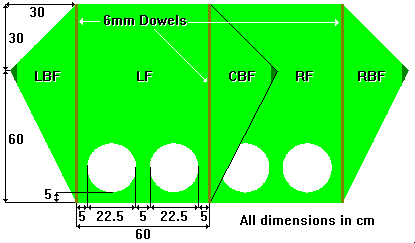
First of all, some terminology. On the diagram above, the following abbreviations are
used: LBF (left bridle fin), CBF (central bridle fin), RBF (right
bridle fin), LF (left foil), RF (right foil). As you read the following
instructions, be sure to refer to the diagram for guidance...
- Plastic binliners, garden sacks or similar may be used. Take care to use the softer,
stretchier forms of plastic - the thin "crackly" types are less resilient.
- The dowels may be obtained from any DIY store. The diameter is not desperately critical,
but approximately 6mm (1/4") does the trick.
- You will need some sticky tape to stick the dowels to the plastic foil. Ordinary sticky
tape is no good. Try using "freezer tape", "garden tape" or
"electrician's tape" (all tough, pliable and fairly water resistant).
- Cut the main foil component (LBF/LF/RF/RBF) from a single piece of plastic if you can.
The CBF component must be cut from a separate piece of plastic, such is life. Scissors may
be used but a craft knife is quicker, easier and more accurate. If you plan to use a craft
knife, get an adult to help you (even if you ARE an adult). A tip: the four
"holes" are easier to cut if you make a card disc template first and mark the
circles on the plastic foil with a suitable pen.
- The dowels must be attached to the front of the kite (i.e. the side which faces you when
you fly the kite). Stick the LBF/LF dowel (left) and the RF/RBF dowel (right) to the foil
using your special sticky tape. If your tape is wide enough, you can do this with one long
vertical strip. If not, use some initiative.
- Stick the central dowel to the CBF component using your special sticky tape. Now stick
the dowel-side of this assembly to the main foil between LF and RF, again using your
special sticky tape and some initiative. Be sure to make this particular junction strong
as it will need to withstand considerable forces in flight (stick both sides of the
dowel to the main foil).
- Now reinforce the free tips of the bridle fins (LBF/CBF/RBF) using copious amounts of
your special sticky tape. If you possibly can, install brass eyelets also as they will
protect against tearing and prolong the life of your sled kite. Brass eyelets aren't cheap
but for a couple of quid you get enough for half a dozen kites or more - share with a
friend...
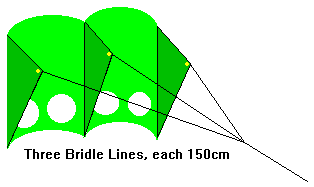
- Finally, construct the bridle from three 150cm lengths of cord, as shown below. You are
now ready to fly your sled kite.
Flying:
- You will need a friend to help you. Semi-rigid kites aren't renowned for self-launching
capability. Unwind a hundred feet of line and take up the tension as your friend holds the
kite open to the wind.
- Make sure you have a suitable "winder" or similar tether at your end of the
kiteline. This kite generates considerable pull and you will not be able to hold the line
barehanded.
- This kite is not easy to land. If the wind is light, you might try running towards the
kite. Being semi-rigid, it should collapse and sink. If the wind is too strong for that
approach, you have no choice but to wind it in yourself or to have your friend walk the
length of the line, bringing it down hand-over-hand.
- Under ideal conditions this kite maintains an unusually high angle of incidence to the
ground, the line often appearing to be close to vertical. Count out 200ft of your kiteline
and attach a small piece of coloured sticky tape to the line at your end. If, when flying,
you can see this tape ahead of your winder, you could be breaking the law.
- This kite is very sensitive to crosswinds and turbulence. If performance is
unsatisfactory (too low or flying on its side) then re-evaluate your chosen site. A flat,
open space is best.
Marcus Morris